
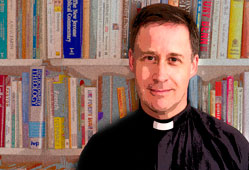
Hugh Valentine - priest beyond the institution
Name
Hugh Valentine
Date ordained
Deacon 1989; Priest 1990
Sphere of work
Social Work until c2005; Educational Foundation since
Why did you become an SSM/MSE/WP?
My formative background had been amongst the Quakers, from the age of 17 to about 29. It was there that I became explicitly Christian. I was greatly influenced by many Quaker 'testimonies' (plain truthful speech, not swearing oaths, and the call to all men and women to share in ministry). Of course, the Friends reject any professional ordained priesthood. So when that 'calling' came my way, I was more than a little thrown by it. Anyhow, I was working as a social worker in Bermondsey, mainly in family cases and child protection. I could not see that it was right to remove my perceived call to be ordained from the context in which it had been given me. I researched the options, came across the history of the worker-priests, and explained to the Higher Powers that I believed the call was to continue in my work.
What's best about what you do?
In 25+ years in social services it was mainly colleagues and the belief that though unglamorous and often stressful, the work was valuable. I felt that strongly as a practitioner, though as a manager and later as director/head of service that primary focus became blurred by target-chasing, budget-balancing and the less attractive aspects of local government politics.
In my present role, as director of an endowed foundation dating from the 1600s and concerned with education as a means of helping children and adults from low-income households escape the cyclic disadvantage, the best aspect is the freedom. The trustees are interested and supportive; the Foundation has historic resources and is free to pursue its aims without interference from politicians, shareholders or regulators. Its brilliant.
Being a priest in a secular setting is challenging. I'd need more space than I have here to begin to explain it (as I have done, elsewhere). Overall, I'd say it has been and is a fantastic and marvellous calling.
What's the most challenging?
Any MSE/WP will say something like 'balancing it all'. I know parish clergy often speak of feeling alone and unsupported, though I think that takes a sharper focus for many an MSE. Frankly, the institution of the church is not interested in this sphere of ministry. There are exceptions, but institutionally, it is blind to this 'fresh expression' of priestly work.
If the church asked, what would you say are the three most important things you have learnt from your work-focused ministry?
- That structural sin is way more significant than individual sin (which the Church majors on, largely mistakenly). The powers and principalities are alive and well and found in the institutions, movements and social exclusions of our day.
- That the business of selling our labour (which the vast majority of people have to do, even those who think that as members of professions they don't really do) is amongst the greatest definers of who we are and the lives we lead. The Church is peculiarly isolated from these things - ignorant in the literal sense of being almost comprehensively uninformed about it. Yet this is the sphere in which God's creative and redemptive work is played out.
- That our patterns of being church, and in particular the way in which the ordained priesthood has developed, undermine the scope of the laity to be the church in the world. No ordained priest or bishop consciously intends that, but it is, by and large, the result.
If the church asked, what would you say are the three most important lessons for it which have emerged from your work-focused ministry?
My impression is that the Church - institutionally - is unlikely to ask. It would require a major change in attitudes. But if it did, I might say -
- Stop seeing church buildings as where God resides and where people must come to encounter that God; it’s a near blasphemy theologically
- Take the defining reality of paid work far more seriously, as this shapes the lives of the vast majority of laity
- Engage with the powers and principalities of today's world, and allow yourself to see what a small, introverted world the church as institution has become.
Why do you think the SSM/MSE/WP development within the CofE
has, to date, been so lack lustre?
I suspect this arises from patterns of selection - who has been chosen for these roles since the development became possible. Although some working class candidates made it, those from respectable professions and who are established in them seem often to have featured. The C of E likes the middle class professionals and "top" people. And someone has to! But what I mean is that if you were wanting to create a body of clergy engaged in a more serious way with the challenges and opportunities raised by the faith in the setting of myriad, ordinary, workplaces, you'd have chosen differently. So we have many unpaid clergy who take seriously their parish pastoral and sacramental duties, but then, as it were, go off to work, not really taking their calling with them. That has shaped the experiment - rather wrecked it in fact. It has brought in extra parochial hands at virtually no cost, but has led to missed opportunities.
I recently had a helpful email exchange with a bishop, though in passing he commented to the effect that the problem with MSE/WPs is that they always complain how unsupported they are! Well, we are! And the evidence seems fairly strong. There is no reason why we can't all move beyond these positions, but it really does require bishops, chapters, diocesan systems to draw us in rather more than they do.
What is it that SSM/MSE/WPs can contribute to the mission of the church today?
Different perspectives. There are so many brilliant parish clergy around but identifying with a single institution, profession or model will, in time, blur the perceptions of even the ablest and most alert.
What do you think SSM/MSE/WPs need to receive from the church in order to be effective in their unique ministry?
Greater interest. Better support. More of a voice.
Would you do it all again?
In a heartbeat.
What about the workers?
(Feast of Joseph the Worker)
Hugh Valentine (MSE, Diocese of London)
Some thoughts on priest workers
(external site)